HAPPY 90TH BIRTHDAY HALMONIE!
It was one of the last days of Korea Blockchain Week in Seoul. With a long weekend approaching, I was even happier to get one of the last bus tickets and escape Seoul's rush hour. The next day, I wanted to celebrate my grandmother's 90th birthday. After a pretty exhausting week full of conferences, meetings, and events, I finally had a few hours to simply look out of the window and think. My grandmother was turning 90. What an incredible number.
Where has all the time gone? My father will turn 70 next year. I'm now 33 myself, and I'm still working pretty hard to make my dreams come true. And whenever I occasionally check Instagram, I could almost believe that I've simply been unlucky over the past few years, while everyone else seems to have become more successful, happier, and wealthier. I started thinking about the old days, when the world still seemed open and full of possibilities.
As a teenager, I didn't have many opportunities to visit my grandparents in Korea. Plane tickets were expensive back then, and when your father is the only one earning money for the entire family, you can't simply fly halfway around the world every year. We were a middle-class family. Still, I have some childhood memories from Korea that I've never forgotten. Back then, my grandmother had a large farm surrounding her house. Everywhere, people were working, planting, and harvesting. I remember her energy, the constant coming and going, and how it felt like every square meter had to serve some kind of economic purpose.
Her home was her workplace, her source of income, her retirement plan, and probably also a pretty good reason to get up in the morning. Today, much of that has disappeared. Some parts of the land have become overgrown. Others are simply empty. Where people used to work, grass now grows. And somehow, it feels as though it wasn't just the farm that became smaller over the years, but also a part of my grandmother's world.
One of my favorite memories is walking beside her on the street as a teenager while she drove her typical grandma scooter to the supermarket.
I still remember the distinctive smell of her house, her swollen hands from all those years of hard work, and her strong voice.
At 90, that voice has become noticeably weaker.
But some things never change.
Her stubbornness, for example.
If it's warm outside but she feels cold, I should still put on a jacket.
When it gets dark, I should probably stop going outside altogether.
And whenever I go jogging in the morning, she keeps asking why I would voluntarily torture myself like that.
I try to explain to her that jogging is healthy.
Maybe she simply doesn't understand.
Or maybe a woman who spent decades working in the fields has a completely different understanding of what physical exercise really means.
She's probably right.
My grandmother was born at a time when Korea was a completely different country.
There was no modern Seoul with its skyscrapers, no K-pop industry, no smartphones, and no Korean technology companies known around the world.
She lived through the final years of Japanese colonial rule, the Korean War, the difficult postwar years, the dictatorships, and eventually South Korea's transformation into one of the most technologically advanced economies in the world.
Some people read about these times in history books.
My grandmother simply lived through them.
And while we spend our time discussing which artificial intelligence can do our work faster, her generation first had to make sure there was enough food on the table.
Her father, my great-grandfather, was a judge in Seoul.
But when he died young from a heart attack, her life changed overnight.
She was still young and, as the eldest child, had to take responsibility for her siblings.
Sometimes I wonder what dreams she had back then.
Did she want to become something in particular?
Did she even have the opportunity to ask herself such questions?
Or did taking care of her family suddenly become more important than anything else?
Today, we constantly talk about making our dreams come true.
Later, she married my grandfather, who was a successful businessman.
But as we all know, being successful doesn't automatically make someone a good husband.
My grandfather also had his less admirable sides.
Women, cigarettes, and alcohol were apparently part of his life too.
And my grandmother had to deal with all of it.
On top of that came the decisions of her children, which certainly didn't always match her traditional expectations.
My mother married a German. My aunt married a Japanese man. One of my uncles got divorced twice.
And even within the family, there were conflicts and distances that couldn't simply be resolved over a family dinner.
I wonder how often she had to accept things in her life that she would never have chosen herself.
And how often she simply carried on, even when she might have preferred to do something completely different.
My grandmother once told me that she could still remember my personality as a child.
Especially how, while playing football, I eventually became so exhausted that I simply lay down in the middle of the game.
Apparently, my stubbornness was stronger than my embarrassment.
I probably inherited that stubbornness from my mother and grandmother.
My mother and her siblings certainly got a pretty generous share of it.
But she also remembers how I treated my grandfather.
Later in life, my grandfather had lost both legs and wore prosthetic legs.
As a little boy, I was honestly afraid of those artificial legs.
Still, I brought them to him every morning.
Because in return, he gave me a piece of chewing gum every day.
Maybe that was my very first real business model.
A small service in exchange for a pretty reliable payment.
Another memory, however, takes me back to Germany.
My grandmother actually flew all the way from Korea to Germany back then.
One of the reasons was to celebrate my birthday with me at kindergarten.
A Korean grandmother who didn't speak English, getting on a plane and traveling halfway around the world without the internet, just to be there for her grandson's birthday.
But somehow, she managed it.
As a little boy, I probably didn't think much about it.
To me, it was simply my grandmother coming to my birthday party.
And hopefully, she had brought a big present.
And somehow, I find it ironic that I later went through a period when I wanted nothing to do with my Korean heritage.
My school years in Germany weren't always easy.
As a German-Korean, I grew up between two cultures.
And although I'm incredibly grateful for that today, it wasn't always easy as a child.
Most of the children around me looked German.
I looked different.
And at some point, I even started rejecting my own Korean culture.
Not necessarily because I truly hated Korea.
But simply because I wanted to belong.
I wanted to be like the other kids.
Not constantly look different or have to explain myself.
Today, I find it pretty sad that I didn't understand back then what an advantage I actually had.
Two cultures, two different worlds, and the opportunity to see things from different perspectives.
It wasn't until my teenage years that I slowly found my way back to my Korean roots.
Today, I'm proud to have grown up between these two cultures.
And yet, there is something I regret.
I wish I had seen my grandmother more often.
Of course, I know that compared to many other children from multicultural families, I was probably quite lucky.
Thanks to my studies in Shanghai and my career in Asia, I was later able to visit my Korean family regularly.
But looking back today, I wish I had spent even more time with her.
More meals together, more walks, more conversations.
More of those seemingly unimportant moments that only become truly important years later.
For a while, I was even able to see my grandmother almost every month.
And that's something I still appreciate incredibly much today.
Sometimes I would stop by just for a meal or a short visit.
Maybe that was one of the most beautiful side effects of my career, something I had never really considered before.
Not the money.
Not the connections.
Not all the events.
But the opportunity to see my grandmother more often.
Back then, she had flown halfway around the world for me.
And many years later, I was able to fly halfway around the world again and again to visit her.
During my bus ride, I kept thinking about how differently our generations had grown up.
Today, we can fly halfway around the world in a matter of hours, communicate with people on other continents within seconds, and theoretically start a company with nothing more than a laptop.
And yet, we're constantly dissatisfied.
I'm 33 years old, and I've already tried quite a few things in life, won some things, and lost others.
Sometimes I feel like I should be much further ahead.
But further ahead than what?
Further than an old school friend who now owns a house?
Or a colleague whose colleague drives a Ferrari?
Or further than the person I was ten years ago?
My grandmother probably never had the time to ask herself these kinds of questions.
She had to work, take care of her family, and somehow make sure life went on.
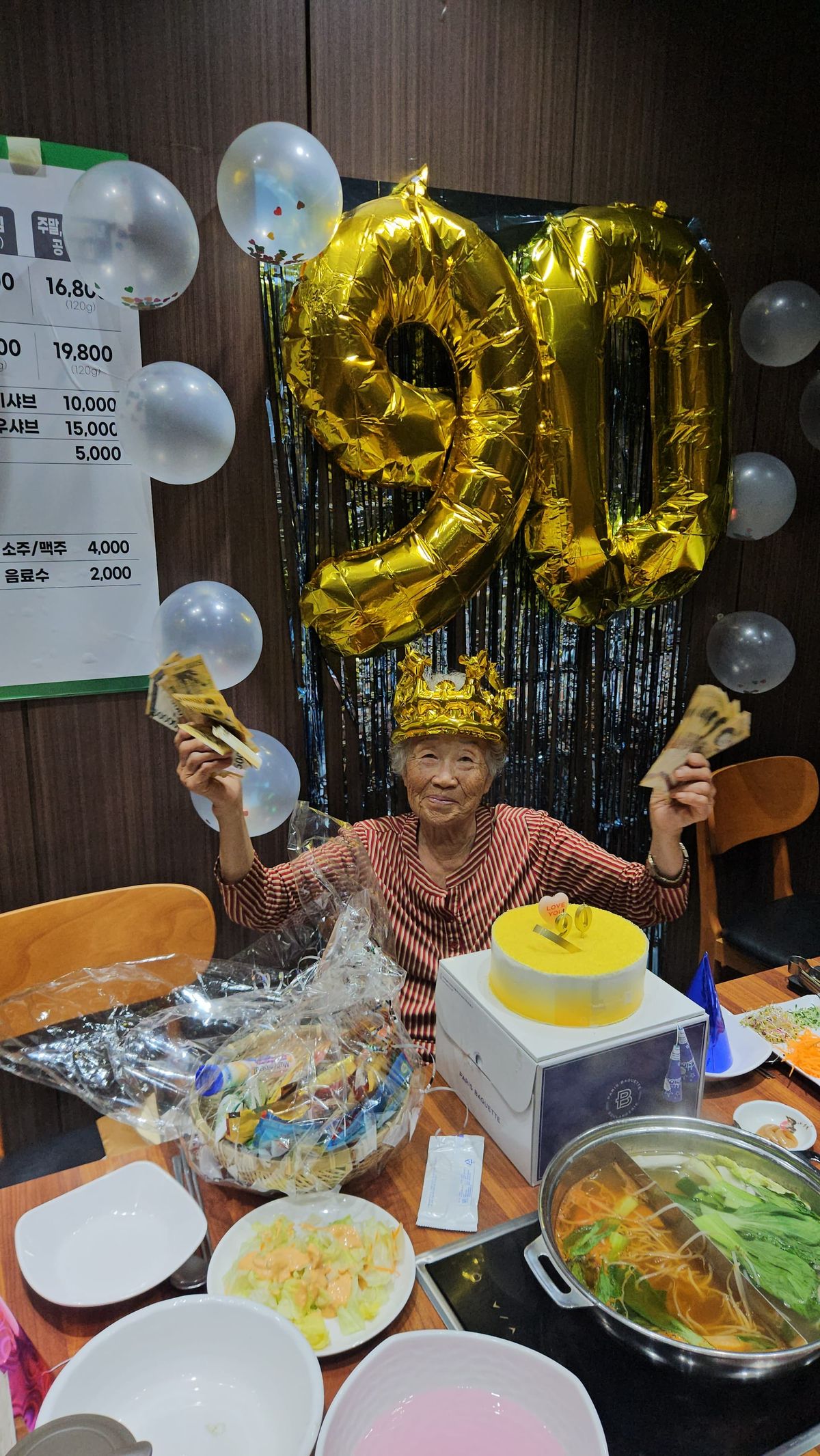
The next day, we finally gathered as a family to celebrate her 90th birthday.
We went to one of her favorite restaurants in Gimje, a rather rural city near Jeonju.
There was Korean hotpot, plenty of vegetables and meat, and of course, the usual discussions you get in a Korean family.
Nothing particularly extraordinary, really.
And yet, that evening felt different to me.
My cousin was pregnant.
My sister was now married, and somehow everyone had their own families.
Suddenly, I had the feeling that time had simply rushed past me.
People I once knew as children are now starting families of their own.
Adults who always seemed the same age to me are starting to get gray hair.
My uncle surprised me the most.
He's usually the most confident eagle I know.
One of those men who walks into a nightclub looking as if he owns the entire place, and who sings out all his pain at full volume during karaoke.
But when we sang Happy Birthday to my grandmother, he suddenly started crying.
I had never seen him cry in my entire life.
Of course, there was one thing that couldn't be missing from a Korean birthday.
Money.
They say money can't buy happiness.
But when it comes to Korean grandmothers, I'm not entirely sure about that.
Sometimes I feel like Korean grandmothers have a very special relationship with money.
Not necessarily because they want to become rich or buy luxury goods.
But because money means something completely different to them.
Security.
Independence.
Care.
And perhaps also the ability to give something back to the people they love.
My cousin, my uncle, my mother, my sister, and the other family members gave her presents and money.
And of course, the yellow 50,000-won banknotes couldn't be missing.
One million won is twenty of those beautiful yellow banknotes.
And for her milestone birthday, she received well over a hundred of them.
When she received the gifts, she started crying.
And when it was time for the birthday cake, she wished all of us good health.
Not wealth.
Not success.
Not some extraordinary careers.
Just health.
I always wanted to buy my grandmother a new house.
Simply a beautiful, comfortable home where she could spend the later years of her life.
Perhaps also as a small thank-you for all the years she spent working for her family.
But the truth is, I still haven't managed to make it happen financially.
And that hurts me deeply.
Because I would love to give something back to her.
My grandmother doesn't drink alcohol or smoke.
Instead, she still works in the garden and in the fields whenever her strength allows it.
And even though she's now 90 years old, she still insists on cooking for us.
Especially her kimchi soup.
Even when we tell her to rest, she just keeps going.
Sometimes I think it's some kind of unwritten law among Korean grandmothers.
As long as someone might still be hungry, the kitchen cannot close.
Maybe that's her way of showing love.
Not through big words or long conversations about feelings.
But by getting up in the morning, preparing ingredients, and making sure her family has something warm to eat.
I don't know how many thousands of meals she's cooked in her lifetime.
Or how many hours she's spent standing in the kitchen.
I thought back to my bus ride and how many days my grandmother had already spent in this extraordinary world.
How many hours she had worked, how many nights she had spent worrying, and how many moments of happiness she had experienced throughout her life.
90 years are approximately 32,870 days, 789,000 hours, or more than 47 million minutes.
And sometimes I already complain when I have to wait ten minutes for something.
I also wondered what it actually takes to reach the age of 90.
And more importantly, how it feels when you've already seen so much of the world.
Does life become easier at some point?
Do you worry less when you're 90?
How often had she been sad?
How often had she been afraid of losing someone?
And how many worries that once seemed enormous don't even matter anymore today?
Maybe worries never really disappear.
Maybe they simply get replaced by new ones.
And while I was thinking about my grandmother's life, another question came to my mind.
What would a tree look like if it were just as old as her?
90 years.
Human beings, too, aren't shaped by time alone, but by what they experience during that time.
My grandmother has lived through wars, economic crises, family conflicts, and personal losses.
And yet, she's still here today.
She even has a smartphone, knows how to use different apps, and now owns cryptocurrencies.
Yes, my 90-year-old Korean grandmother owns cryptocurrencies.
I wonder what she would have thought if someone had told her as a young girl what the world would look like on her 90th birthday.
She probably wouldn't have believed them.
And maybe she would have asked them afterward if they'd eaten anything yet.
The more I think about her life, the more I realize how little I actually know about it.
I know many stories about my grandmother.
But I don't know all her thoughts.
I don't know how she felt when she lost her own parents.
Were there still things she wanted to tell them?
Did she regret anything?
Or was there simply no time back then to spend too long thinking about such feelings?
If she could start her life all over again, would she do anything differently?
But have I ever actually asked her whether she's happy with her life?
Maybe sometimes we're afraid of the answer.
I want to ask her what she considers true wealth today.
And what advice she would give her 33-year-old grandson, who is still trying to make his dreams come true.
But maybe she would simply tell me to eat more and put on a jacket when it's cold outside.
Both would be pretty typical of her.
In the end, it was actually just a relatively short birthday celebration at a restaurant.
A family dinner, a birthday cake, a few presents, and some tears.
But moments like these aren't something you can simply make up for later.
Sometimes I think about how incredibly unlikely it is that we even exist in this world.
How many decisions, encounters, and coincidences had to come together for me to be sitting here today?
If my grandmother had lived a different life, if my mother had never met my father, or if just one single decision had turned out differently, I probably wouldn't exist as the person I am today.
I hope that in the coming years, my wishes for her will still come true.
That she stays healthy and happy, and that we still have as many years together as possible.
That she gets to watch my son grow up, and that we can create many more memories together as a family.
And maybe, one day, I'll actually manage to buy her that house.
Maybe we don't have to understand every decision someone has made to have enormous respect for the life they've lived.
And maybe not every year of our own lives has to be a success.
Sometimes, it's enough to simply keep growing.
Like an old tree.
Happy 90th Birthday, Halmonie.
And thank you for being one of the reasons I'm alive today.